API Reference
Error responses
Every error response — 401s and 429s from middleware, 404/422/500s raised anywhere in app/api/endpoints/ — has the same shape:
{ "error": "Not Found", "detail": "Trace 'abc123' not found" }
error is the standard HTTP reason phrase for the status code; detail is the specific message. Client code should read detail for the message and can use error as a stable, status-code-derived category if useful.
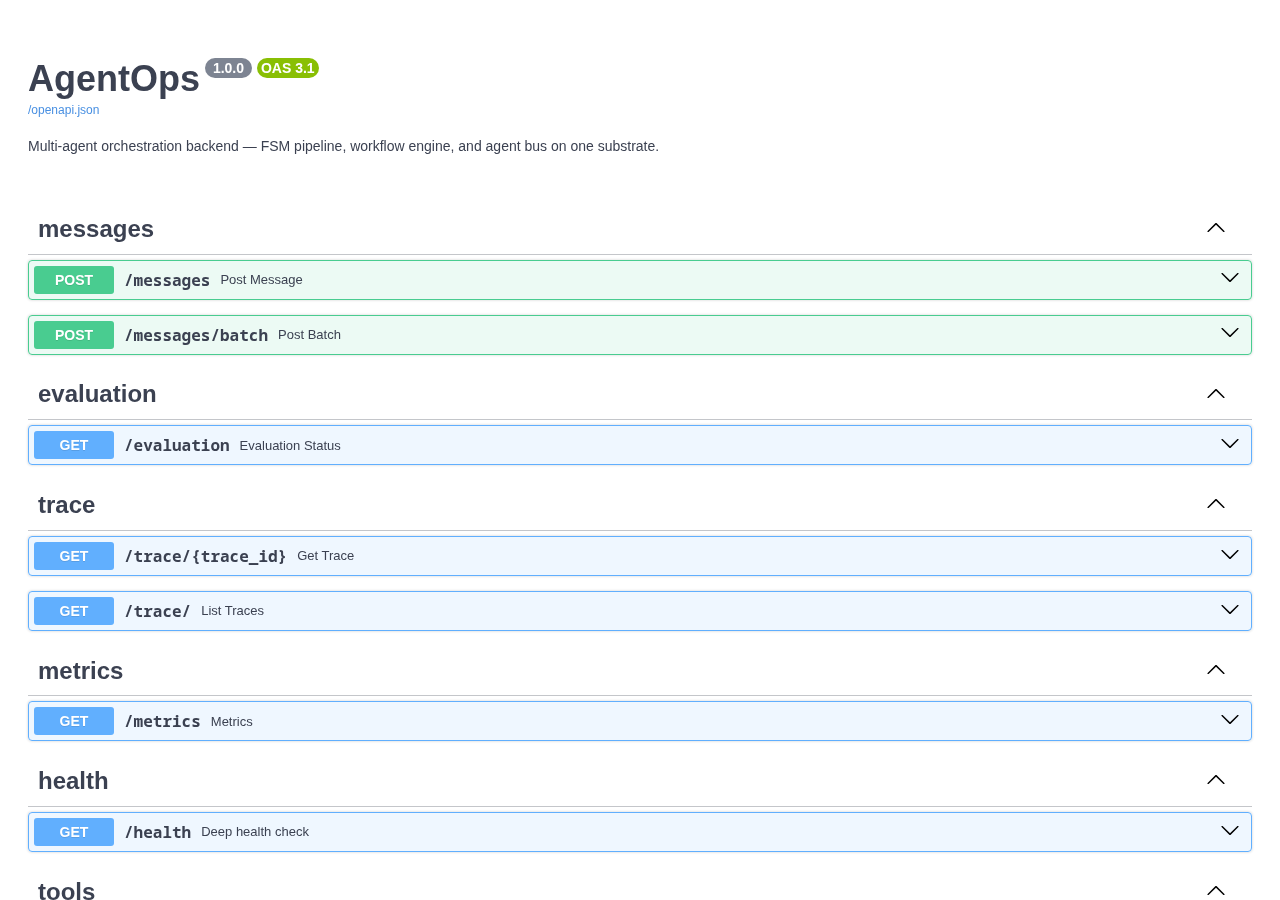
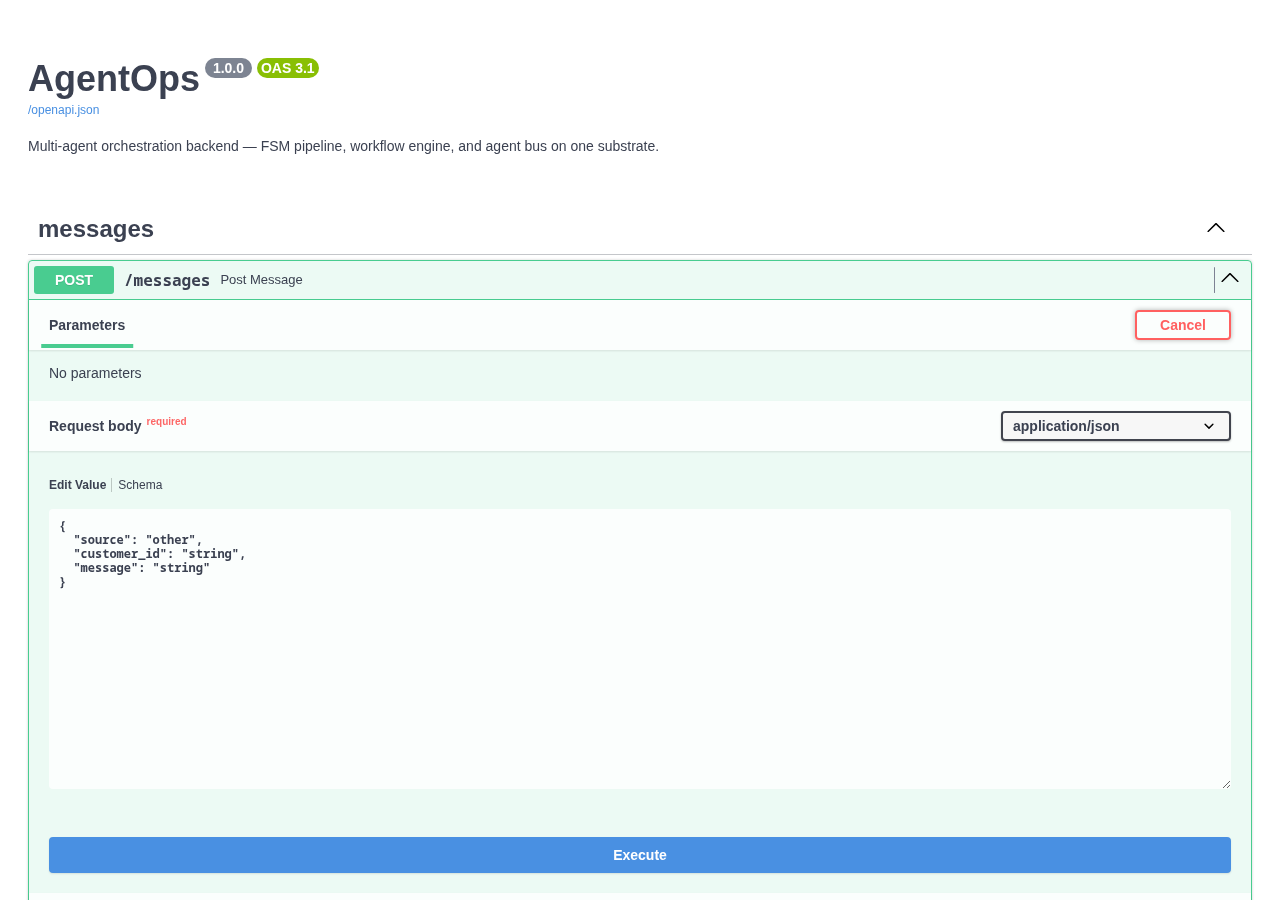
POST /messages / POST /messages/batch
Runs a message through the FSM pipeline. batch processes all messages concurrently.
// Request
{ "source": "ticket", "customer_id": "cust_123", "message": "I want a refund" }

// Response
{ "trace_id": "550e8400-...", "intent": "refund", "confidence": 0.8, "escalated": false, "response": "..." }
Workflows
| Route | Description |
|---|---|
POST /workflows |
Create a workflow definition. Validates the DAG (cycles, dangling deps) at creation, not at run time. |
GET /workflows |
Paginated list of definitions. |
GET /workflows/{id} |
Fetch one definition. |
DELETE /workflows/{id} |
Delete a definition. |
POST /workflows/{id}/run |
Execute. Blocks until completion by default; pass "background": true to get a pending execution back immediately and poll for the result. |
GET /workflows/{id}/runs |
Paginated execution history. |
GET /workflows/{id}/runs/{execution_id} |
Fetch one execution's status and step results. |
Each step is "kind": "tool" (dispatches to the tool registry) or "kind": "agent" (dispatches to the agent bus). Steps in the same DAG layer run concurrently via asyncio.gather; a step can reference an upstream step's output with "$step.<id>.<key>".
No idempotency-key support. POST /workflows/{id}/run has no Idempotency-Key header or equivalent deduplication — if a client retries after a timeout, the workflow runs again. This matters most for non-idempotent tool steps (anything with a real side effect, not the bundled example tools). If you need retry-safety here, build it at the call site today (e.g., check GET /workflows/{id}/runs for an existing in-flight/completed execution before retrying) — it isn't handled server-side yet.
Agents
| Route | Description |
|---|---|
GET /agents |
List registered agents (name + description). |
POST /agents/route |
Dispatch a goal. Supply subtasks explicitly, or omit them to use the configured decomposer (OpenAI if OPENAI_API_KEY is set, otherwise a deterministic keyword matcher). |
GET /agents/routes |
Paginated routing history. |
GET /agents/routes/{routing_id} |
Fetch one routing run. |
RoutingResult.status is completed (all subtasks succeeded), partial (mixed), or failed (all failed) — one subtask failing never cancels the others. Same idempotency caveat as workflows above: a retried POST /agents/route re-dispatches every subtask.
No per-key data isolation. Any valid API key can read every trace, workflow, and routing record in the deployment, regardless of which key created them. See docs/architecture.md's Authentication section if this matters for your deployment.
Observability & ops
| Route | Description |
|---|---|
GET /trace/{trace_id} |
Full execution timeline for a /messages request — state transitions, tool calls, agent decisions. |
GET /trace/ |
Paginated trace listing. |
GET /metrics |
Prometheus exposition format. |
GET /health |
Liveness + dependency readiness (redis, openai). |
GET /tools |
Registered tool names and input schemas. |
POST /evaluation |
Runs the evaluation harness on synthetic ticket data. |
Interactive, always-current API docs (OpenAPI/Swagger) are served at /docs on a running instance: